
In this blog, I’m giving you my easy 6-step process to getting dosage calculation problems right EVERY TIME.
Here’s what we’ll cover:
- The simple 6-step process for getting dose calc problems right every time
- The MUST KNOW tips you need to follow when answering dosage calc problems, or you may end up getting them WRONG
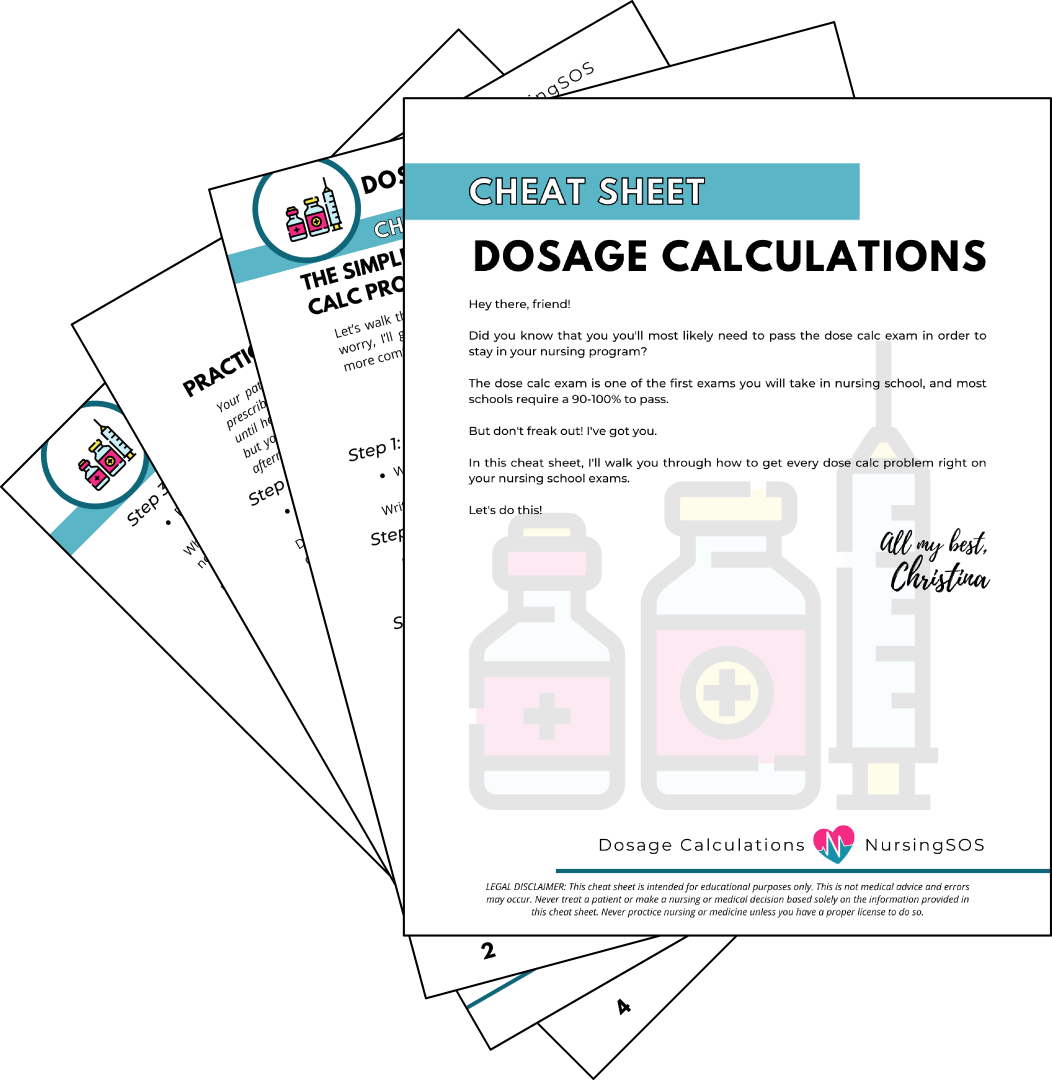
Click here to grab your
Free Dose Calc Cheat Sheet
This FREE cheat sheet will walk you through the simple 6-step process for getting dose calc problems right every time!
6 STEP PROCESS AND EXAMPLE
So here’s our practice problem, and I’ll explain the steps as we go along.
Your patient, Mary, has been hospitalized for 4 days for bacterial pneumonia. She is prescribed 250mg of Levofloxacin to be taken orally once per day for the next 14 days until her next appointment. You are getting ready to pass her morning meds but you only have 500mg tablets in your med cart. Mary is going to be discharged this afternoon. How many milligrams total will Mary need to go home with?
STEP 1: FIGURE OUT WHAT YOU NEED
So the first step is to figure out what you need, you need to decide what the question is actually ASKING you for. This is step number one because you need to find out what you need to end up with at the end, so that you know what conversion factors to use. It’s really important that you do this first, or you’ll end up with the wrong answer. And you don’t want that!
So let’s figure out what the problem is actually asking us for. At first glance, this question looks like you need to figure out how many tablets Mary will be receiving. But it is actually asking you how many MILLIGRAMS Mary will need to go home with. You need to read the entire question before you decide what the question is really asking.
So let’s write this on the right hand side of the paper. We need the total MILLIGRAMS that Mary will go home with.
So step number 1 is to figure out what the question is asking you for. What do you need to end up with?
STEP 2: FIGURE OUT WHAT THE ORDER IS
Now, step number 2 is to figure out what the order is. What did the doctor originally order? What is the original order that we are trying to convert?
In this example, the doctor ordered 250 miligrams to be taken once per day. This is what the original order said, this is what we’re starting with. So you’ll write this on the left hand side of your paper.
STEP 3: FIGURE OUT WHAT CONVERSION FACTORS YOU NEED TO USE
Now step number 3 is to figure out what conversion factors you need to use. These are the conversions that you need to use to get to the end result.
What medication or unit does the question make available to you? Are you needing to convert grams to milligrams? Minutes to hours? Or milliliters to drops?
Pick out the information that pertains to the answer you need, and cross out any unnecessary details. If the test is on paper, I like to physically cross out information I do not need to keep me from getting distracted.
In this case, we are keeping the dosage unit in milligrams, but we need to figure out how many milligrams she needs for 14 days.
So for our example, the only information we need is
- Her prescribed dose (of 250 milligrams)
- How often she takes it (once per day)
- How long she will be taking it (14 days)
We do not need to pay attention to the other details, such as how long she’s been in the hospital and how many milligrams the tablets are in the med cart. Because remember, this question isn’t asking us for the number of tablets she needs, it’s asking us for how many milligrams she needs.
You’ll write all of the conversions you’ll use in the middle of the paper, in between the order and what you need.
Now when you’re writing out these conversion factors, you need to make sure that they are structured correctly and that the units will cross out. It’s important that the units you don’t need to end up with at the end are on opposite sides of one another: one on the top and one on the bottom. That way they will cross each other out.
STEP 4: SOLVE THE PROBLEM
Now step number 4 is to solve the problem. Multiply across the top line. Multiply across the bottom line. And divide both of those numbers. This is a super awesome fraction trick that does the conversions for you, and one of the top reasons why I love writing out dosage calculations this way.
You need to make sure you set it up correctly in the first place, but once you make sure it’s all good, it’s super easy to just multiply across the top, multiply across the bottom, and then divide.
STEP 5: WRITE THE ANSWER APPROPRIATELY
Now, onto step number 5, which is to write the answer appropriately. One of the BIGGEST mistakes nursing students make when taking your dosage calculation exam is that you don’t round correctly, or you don’t write the answer correctly. So there are 2 rules you need to know.
RULE #1
The first rule is when you’re using this dimensional analysis method, don’t round the answer until the very end. So as you’re multiplying across the top and bottom, just write those numbers exactly how they are, don’t round them until AFTER you divide and get the final answer. If you round the top and bottom numbers before you divide, the answer may be off and you’ll get it wrong.
RULE #2
And the second rule you need to follow is to remember this mnemonic: nurses are leaders, not followers. This means that you include leading zeros, but not trailing zeros.
Let’s say your calculator said something like .5. We wouldn’t write this answer as just .5 because imagine how easy it would be for that decimal point to get lost and the dose to turn into 5.
And we definitely wouldn’t write it as .50 for the same reason. That decimal might get lost and someone might think it says 50, and that would be very bad!
So, friend, no trailing zeros! You need to watch them at all times, so keep them in front!
The only correct way to write it is 0.5. Even if the decimal gets lost, it will look like 05, causing other nurses to double check where the decimal is.
For our above example, the answer is 3 thousand 5 hundred milligrams (3500). We would not write it as 3 thousand 5 hundred point zero zero milligrams (3500.00), 3 thousand comma 500 milligrams (3,500), or 0 3 5 0 0 milligrams (03500). Simply write it as 3 5 0 0 milligrams (3500).
STEP 6: CHECK YOUR WORK!
And finally, the last step is to check your work. It’s super important to check that you got it right, because we all make mistakes sometimes, but the patient’s life depends on this. It’s really important that you be diligent and double check your math.
Seriously, friend, save yourself the stress and anxiety that comes with questioning yourself or hurting your patient just because you didn’t take the extra few seconds to check your calculations.
Take a step back, breathe, and do the problem again. Safe nursing practice is always your number one priority.

Our products are packed with resources to help you pass your exams (like step-by-step guides, flashcards, and workbooks).
DOSE CALC TIPS
So even though you’re now a PRO at solving those dosage calculation problems, there are some KEY TIPS that you MUST remember when solving these problems, or you might end up getting them wrong.
TIP #1
The first one is to read the entire question FIRST! This tripped me up many time on my dose calc exams in nursing school. I would start reading the question, assume that I knew what it was asking, and then I would solve it accordingly. But then when I went to check my work, I found that I was solving for the wrong thing, like I had the wrong units or something.
It’s so easy to just assume that you know what the question is asking, when really it’s asking for something else. But you wouldn’t catch onto that unless you actually read the entire question in the first place! So when you sit down to take your exam, make sure to read the entire question FIRST.
TIP #2
Now tip number 2 is to learn and memorize the dosage calculation conversions that you need to know. There are no 2 ways around it, you MUST memorize these. Like 1 milligram equals 1000 micrograms, 1 liter equals 1000 milliliters, there’s 3 teaspoons in 1 tablespoon, 30 milliliters in one ounce, and 1 kilogram is 2.2 pounds. I have a free cheat sheet with all of these listed, plus a lot more, so it will be really handy for you as you learn these conversions. I’ll put the link to the cheat sheet in the description.
TIP #3
The next tip I have for you is to use the dimensional analysis method like we did in all of our practice problems. I sometimes see nursing students using different formulas for solving these equations, and that’s okayyy if you’re SUPER confident in it. But if you’re like me and you’re not super confident in your math skills, using dimensional analysis, or the rail road method, or rail road tracks, whatever you want to call it – it just works a TON better! Because literally, all you need to do is put the numbers in the right place, multiply across the top, multiply across the bottom and divide. That’s it. It’s full proof and you’ll get it right every time as long as you set it up correctly.
NursingSOS Membership Community
Your step-by-step guide to passing nursing school
You're 100% capable of passing nursing school. Let's make it happen!
Premium nursing lectures to help you pass without stress and overwhelm.
TIP #4
The next tip is to do practice problems over and over again. Really the BEST way to gain confidence in solving dosage calculation problems is to practice it again and again and again. If you’re a NursingSOS Member, sign into your dashboard and check out the dosage calculation workbook we have for you that’s filled with practice problems. The more you practice, the better and more confident you’ll get at it!
Related Blogs



Now click on one of these blogs below to keep rocking nursing school and go become the nurse that God created only You to be!
Latest Blogs

Diabetic Ketoacidosis Pathophysiology (with MEMORY TRICKS!)
In this video, we're walking through the pathophysiology of diabetic ketoacidosis, or DKA, PLUS the MUST KNOW info you need to know about the patho to pass your nursing school exams and the NCLEX®! Let's dive in! 🩺 10 FREE Study...

Heart Failure Nursing Diagnosis (Plus A Full Nursing Care Plan!)
In this video, we're walking through a NURSING DIAGNOSIS and a FULL CARE PLAN for left sided heart failure! You're going to see this disorder all the time at clinical, talk about it a lot in nursing school, get tested on it, and write a lot of care plans about on it....

3 things I wish I had been MORE PREPARED FOR in nursing school…
In this video, we're talking about 3 things that I wish I had been more prepared for in nursing school. So whether you're just starting school now or you're already in nursing school, I hope this video will be an encouragement to you and help you stay focused and...